Vienna Database
View allAll Photos Tagged database
I bless the day I found you
I want to stay around you
And so I beg you, let it be me
Don't take this heaven from one
If you must cling to someone
Now and forever, let it be me
Each time we meet love
I find complete love
Without your sweet love what would life be
So never leave me lonely
Tell me you love me only
And that you'll always let it be me
Each time we meet love
I find complete love
Without your sweet love what would life be
So never leave me lonely
Tell me you love me only
And that you'll always---let--it be--me
Pierre Delanoë (original in French, 1955) / Manny Curtis 1957 / The Everly Brothers 1959
The Mapmaker’s Song
The mapmaker downed his tools.
I’ve caught it, every alley, every street,
every fanlight and window-ledge,
the city fixed and framed.
Now I want everything else.
I want to be a historian of footsteps,
a cartographer of hemlines and eyelids,
I want to catch what the pavements say
when they sing to each other
in their deep laboratories, plotting
every journey since the place began.
I want the whole
unlosable database, the repeating place,
kings stalking the server farms,
tailbacks and looped alarms,
I want to be where
brushstrokes flicker on a bank of screens,
where graveyards tilt
and quiet populations crowd the air,
their quarters risen again
their furniture
smashing through the floors.
I want to stand at the centre
of a great clutter
mapping ashes, mapping bones,
archivist, enumerator, hanger-on
signing the returns
of an infinite census.
I want to be,
beyond everything I’ve reached or drawn,
not much at all, or all there is,
a geographer of breath,
a curator of hands.
I want to lie in the atrium
of the museum of the fingertip
and touch, touch, touch.
Peter Sirr
Whoo finally I have done another database picture. I figure I should do this while I can.
After all, future is uncertain. Anyway my collection is incomplete, you can visit Angel Den for more info.
These hands are exchangeable on SD10 Girl, SD10 Boy, SD13 Girl and SDGr Girl.
You can see their compatibility on SDG vs SDGrG body here. I hope this will be useful. ^__^
Photo taken by Chris Witt, scan kindly provided by Michael Bernhard for inclusion on this page.
München-Riem
January 1982
9Q-CBJ
Lockheed L-100-30 Hercules (L-382G)
382-4796
Scibe Airlift Zaire
Delivered to Safair in November 1978 and leased to Scibe Airlift till October 1988; went on to Pegasus Aviation as N123G in January 1989, to Rapid Air Transport as N8183J in February 1989 (operating for Tepper Aviation) and to Q2P as N2679C in October 2006. (Source: rzjets.net) Still active in 2023.
Registration details for this airframe:
www.c-130.net/aircraft-database/C-130/airframe-profile/8074/
9Q-CBJ with Scibe Airlift at OST in April 1987 (slightly revised colours):
www.c-130.net/g3/var/resizes/c-130-photos/Civilian%20L100...

This airframe as N8183J with Tepper Aviation in November 1999:
www.flickr.com/photos/habujet/35230354286
This airframe as N2679C at Shannon in April 2020:
www.flickr.com/photos/shanair/49770668912
Scan from Kodachrome slide.
Photo taken by Andreas Rink, slide kindly provided for scanning by Florian Weiß.
München-Riem
May 1982
CCCP-86012
Ilyushin Il-86
51483202010
Aeroflot
Smokey touch-down on Riem‘s runway 25.
Delivered to Aeroflot in September 1981; to Uzbekistan Airways as UK-86012 in 1992/1993; leased to KrasAir in 2001; stored at TAS in 2003 and broken up there (no longer present in December 2006). (Source: scramble.nl)
Detailed information on this airframe:
www.scramble.nl/database/soviet/details/86_60570
russianplanes.net/reginfo/1419
This airframe as UK-86012 with Uzbekistan Airways at SHJ in 1996:
russianplanes.net/images/to61000/060452.jpg
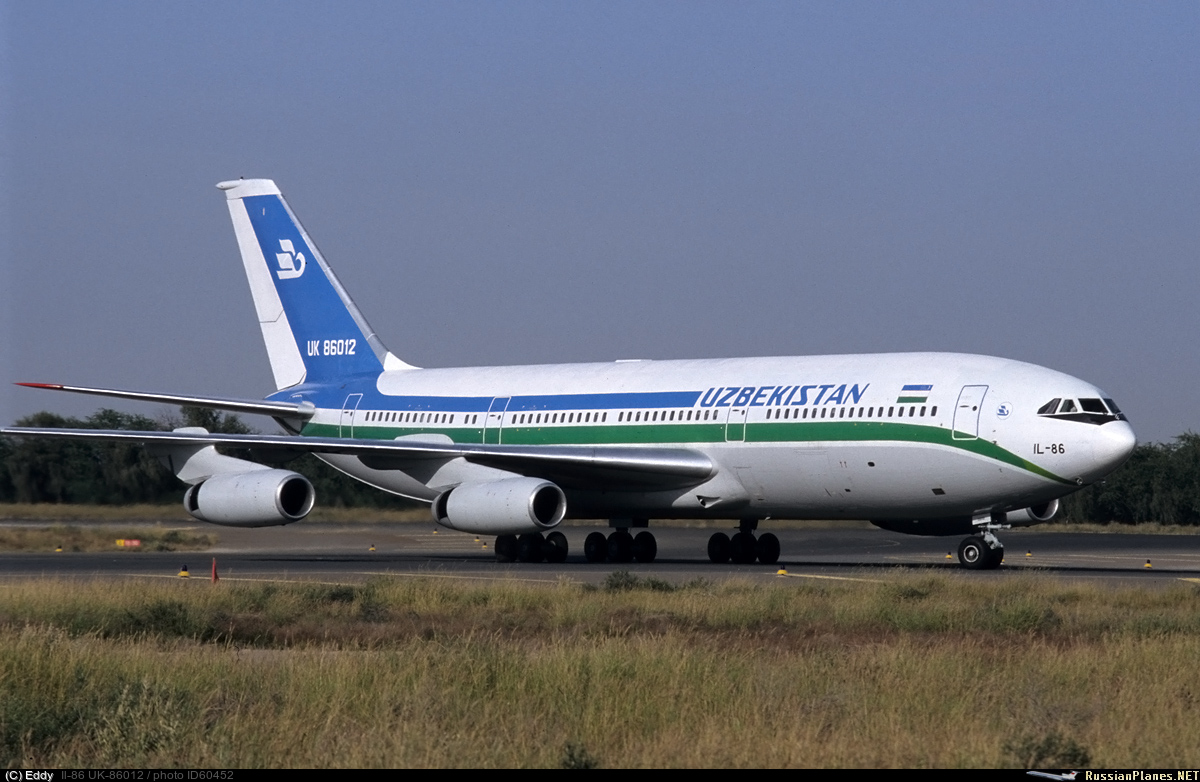
UK-86012 with KrasAir stored at SVO in August 2001 (basic Uzbekistan colours):
www.flickr.com/photos/nxgphotos/6577522741
Scan from Kodachrome slide.
Photo taken by Robert Samweber, slide kindly provided for scanning by Florian Weiß.
München-Riem
November 1985
OE-ILD
British Aerospace BAC-111-525FT One-Eleven
256
Lauda Air
This One-Eleven was noted at Riem before as YR-BCM with TAROM on 6 June 1978. Aero Lloyd Caravelle D-ACVK is parked behind.
Information from flickr - thanks to Guido Allieri (slightly adapted):
BAC 111-525FT c/n 256 was delivered to TAROM as YR-BCM during August 1977. In 1985 and 1986 it was leased two times to Lauda Air (OE-ILD), returning to TAROM at the end of July 1986. In April 1987 the plane was leased again to BIA British Island Airways for the summer season, returning to TAROM at the end of July 1987. retired by TAROM in May 1988, the plane was sold to Ryanair as EI-BVI. Ryanair operated it until September 1993 when the plane returned again to TAROM. This plane was damaged beyond economical repair and so written-off at Stockolm-Arlanda on June 07th, 1997. Hulk acquired by Caravelle Club, traded to RSwedAF for a Caravelle and trucked 600 kms to Halmstad for use as a fire & rescue trainer.
Registration details for this airframe:
www.scramble.nl/database/civil/details/bae111_256
This airframe as YR-BCM with TAROM at HEL in July 1979:
imgproc.airliners.net/photos/airliners/6/6/4/0678466.jpg

YR-BCM with TAROM at LHR in January 1985 (later colours):
www.flickr.com/photos/l8rmt/50444878036
YR-BCM leased to British Island Airways at MXP in July 1987:
www.flickr.com/photos/guidojet/51311071446
This airframe as EI-BVI with Ryanair at DUB in August 1990:
imgproc.airliners.net/photos/airliners/5/3/7/0822735.jpg

EI-BVI with Ryanair at SNN in May 1992 (later colours):
www.flickr.com/photos/24101413@N03/20573399278
YR-BCM with TAROM at ARN in August 1996 (later colours):
imgproc.airliners.net/photos/airliners/4/7/1/1102174.jpg

YR-BCM with TAROM following its last landing at ARN on 7 July 1997:
imgproc.airliners.net/photos/airliners/9/7/1/0486179.jpg

YR-BCM being dismantled at ARN in September 1999:
imgproc.airliners.net/photos/airliners/8/4/4/0922448.jpg

The remains of YR-BCM at HAD in August 2004 (Le Caravelle Club titles):
imgproc.airliners.net/photos/airliners/0/6/3/1121360.jpg

Scan from Kodachrome slide.
All images available for licensing via me. I offer commercial and editorial pet photography on a commissioned basis. And with a pet picture database with hundreds of hand-picked images of dogs, cats, as well as horses, I might already have what you are looking for. All pictures here can be licensed.
For licensing and commission requests: info{at}elkevogelsang.com -
FACEBOOK | INSTAGRAM | WEBSITE
© Elke Vogelsang
20160615_Scout_Taurus_GoofyTroll
GIMP 3.2.0-RC2 in Debian Forky
Remastered means shots post processed from published in Przemyslaw_NH (Flickr) or from database of unpublished.
All images available for licensing via me. I offer commercial and editorial pet photography on a commissioned basis. And with a pet picture database with hundreds of hand-picked images of dogs, cats, as well as horses, I might already have what you are looking for. All pictures here can be licensed.
For licensing and commission requests: info{at}elkevogelsang.com -
FACEBOOK | INSTAGRAM | WEBSITE
© Elke Vogelsang
20201220_Ioli_SlobberinDaHood
T577 - Jason [about to mount the ship Argo] taking leave of Chiron, who is carrying the infant Achilles on his back –
Kromos; Cornelian
********************************************************************************
Beazley Archive Gems Search
www.beazley.ox.ac.uk/xdb/asp/gemsSearch.asp?LastMenuPageI...
All images available for licensing via me. I offer commercial and editorial pet photography on a commissioned basis. And with a pet picture database with thousands of hand-picked images of dogs, cats, as well as horses, I might already have what you are looking for. All pictures here can be licensed.
For licensing and commission requests: info{at}elkevogelsang.com -
FACEBOOK | INSTAGRAM | WEBSITE
© Elke Vogelsang
20240308_Käthe_TrustAndPatience
licensing dog images
licensing dog photos
licensing dog photo
licensing pet photos
licensing pet photos
stock images of pets
stock images of dogs
commercial dog photographer
commercial pet photographer
commercial dog photography
commercial pet photography
commercial dog photograph
commercial pet photograph
commercial dog photographs
commercial pet photographs
studio dog photograph
studio dog photography
studio dog photographs
studio pet photograph
studio pet photography
studio pet photographs
license images of dogs
license images of pets
commercial license
commercial licenses
commercial licenses for dog photos
commercial licenses for dog photos
buy commercial license for dog photos
buy commercial license for dog photo
buy commercial license for pet photos
buy commercial license for pet photo
commercial licenses for pet photos
commercial licenses for pet photo
pet image archive
dog image archive
stock photos of dogs
stock photos of pets
buy dog photos
buy pet photos
buy cat photos
buy dog images
buy pet images
buy cat images
Format: Glass plate negative.
Rights Info: No known restrictions on publication.
Repository: Tyrrell Photographic Collection, Powerhouse Museum www.powerhousemuseum.com/collection/database/collection=The_Tyrrell_Photographic
Part Of: Powerhouse Museum Collection
General information about the Powerhouse Museum Collection is available at www.powerhousemuseum.com/collection/database
Persistent URL: http://www.powerhousemuseum.com/collection/database/?irn=29364
Acquisition credit line: Gift of Australian Consolidated Press under the Taxation Incentives for the Arts Scheme, 1985
Format: Glass plate negative.
Rights Info: No known restrictions on publication.
Repository: Tyrrell Photographic Collection, Powerhouse Museum www.powerhousemuseum.com/collection/database/collection=The_Tyrrell_Photographic
Part Of: Powerhouse Museum Collection
General information about the Powerhouse Museum Collection is available at www.powerhousemuseum.com/collection/database
Persistent URL: http://www.powerhousemuseum.com/collection/database/?irn=30033
Acquisition credit line: Gift of Australian Consolidated Press under the Taxation Incentives for the Arts Scheme, 1985
#If you are like me your computer database is awash with photo images Rather than trash them, I've decided to revisit some of my previous trips, hopefully some of these will have some appeal
#Embracing street photography for a journey to Rome, Italy, in June 2024 turned out to be an enthralling experience.
#Our lodging on Via Cavour was exceptional, nestled in the city's core, mere steps away from the Roman Forum and the Colosseum.
#In Rome, history and art are visible at every turn. Our visit also aligned with the National Republic Day, presenting further opportunities for photography.
Format: Glass plate negative.
Rights Info: No known restrictions on publication.
Repository: Tyrrell Photographic Collection, Powerhouse Museum www.powerhousemuseum.com/collection/database/collection=The_Tyrrell_Photographic
Part Of: Powerhouse Museum Collection
General information about the Powerhouse Museum Collection is available at www.powerhousemuseum.com/collection/database
Persistent URL: http://www.powerhousemuseum.com/collection/database/?irn=28344
Acquisition credit line: Gift of Australian Consolidated Press under the Taxation Incentives for the Arts Scheme, 1985
Format: Glass plate negative.
Rights Info: No known restrictions on publication.
Repository: Phillips Glass Plate Negative Collection, Powerhouse Museum www.powerhousemuseum.com/collection/database/collection=Phillips_Glass_Plate_Negative
Part Of: Powerhouse Museum Collection
General information about the Powerhouse Museum Collection is available at www.powerhousemuseum.com/collection/database
Persistent URL: http://www.powerhousemuseum.com/collection/database/?irn=386422
Acquisition credit line: Gift of the Estate of Raymond W Phillips, 2008
Country: SPAIN
Operator: RENFE
Item: STATION & ELECTRIC
Class or Maker:
Wheel Arrangement or Type:
Number: 8917
Place details: BILBAO ABANDO Station
Additional notes: Gauge 1674mm adjusted later to 1668mm
4-4-0T No.29 in the background
Original source material: 35mm colour slide
Photographer: John Sloane
Copyright: Photographer
Library locator reference: JSLO_1977
30937 Transport Photograph Database
1977APR18JSLO0321cs
With a model database of dozens of 100 dogs and cats I offer commercial and editorial pet photography on a commissioned basis. And with a pet picture database of more than 1400 images, I might already have what you are looking for. All pictures here can be licensed.
For licensing and commission requests: info@elkevogelsang.com
________________________
Elke Vogelsang
Commercial and editorial pet photographer
info@elkevogelsang.com
________________________
All pictures: © Elke Vogelsang
20200302_Vegas_Vegashere_CUTO
You can download or view Macroscopic Solutions’ images in more detail by selecting any image and clicking the downward facing arrow in the lower-right corner of the image display screen.
Three individuals of Macroscopic Solutions, LLC captured the images in this database collaboratively.
Contact information:
Mark Smith M.S. Geoscientist
mark@macroscopicsolutions.com
Daniel Saftner B.S. Geoscientist and Returned Peace Corps Volunteer
daniel@macroscopicsolutions.com
Annette Evans Ph.D. Student at the University of Connecticut
annette@macroscopicsolutions.com
Had a chance to work on some lensless "landscape" photography this weekend. This is a 5-frame in-camera multiple exposure. Months of evaluating and categorizing pieces of glass cullet, plastic, and artistic glassware has yielded a kind of database and vocabulary of caustic patterns. The advent of in-camera multiple exposures has allowed reduction of what used to be hours upon hours of assessing each step of a multi-burn single exposure then figuring out how to sequence it using multiple tripod stations to minutes of hand-held wonder. The ability to see the composition live greatly reduces the effort required to build a composition and decreases the the likelihood of misalignments. It's too easy! Ingredients: Photon Micro light LEDs, 4 pieces of glass/glassware, black plastic masking elements, a few clamps.
With a model database of dozens of 100 dogs and cats I offer commercial and editorial pet photography on a commissioned basis. And with a pet picture database of more than 1400 images, I might already have what you are looking for. All pictures here can be licensed.
For licensing and commission requests: info@elkevogelsang.com
________________________
Elke Vogelsang
Commercial and editorial pet photographer
info@elkevogelsang.com
________________________
All pictures: © Elke Vogelsang
20100918_Noodles_BeachGuard
(Chamaeleo senegalensis - Daudin 1802 - Ssp Laevigatus - Gray 1865) B28I4237 Near Murchinson Falls - Uganda
Finally i got a correct identification after some research.
This one is a female because, for this species, females are larger than males.
This species (wikipedia source) occurs in Mauritania, Senegal, Mali, Gambia, Guinea-Bissau, Guinea, Sierra Leone, Liberia, Côte d'Ivoire, Ghana, Togo, Benin, Nigeria, Cameroon and Central Africa (the country).
But i have a very specialized book (Petr Necas - Caméléons Joyaux cachés de la nature - Editions Chimaira) which states that the distribution of this species also includes Sudan, Ethiopia, Kenya and Tanzania. He does not speak of Uganda but South Sudan and Uganda are contiguous.
On the different photos that I have, there does not seem to be any doubt, backbones, helmet and global morphology, all indicate a Chamaleo senegalensis.
There are subspecies described in the Great Lakes region: Chamaeleo laevigatus (Gray 1865). I found confirmation of this subspecies in reptile-database.reptarium.cz; Chameleon of East Africa's checklist.Inaturalist.org and CAMALEONTIamo ITALIA. Although Uganda is not mentioned by name, there seems to be no doubt with the help of the photos.
As for the way we met it, we stopped to photograph a bird and it was at our feet. Saul our Ugandan guide all excited me and I took a minute to find it ... We had 3 different species of chameleons on this trip.
Selon un article de Wikipédia, cette espèce se rencontre en Mauritanie, au Sénégal, au Mali, en Gambie, en Guinée-Bissau, en Guinée, en Sierra Leone, au Liberia, en Côte d'Ivoire, au Ghana, au Togo, au Bénin, au Nigeria, au Cameroun et en Centrafrique.
Mais je possède un livre spécialisé (Petr Necas - Caméléons Joyaux cachés de la nature - Editions Chimaira) qui précise que la répartition de cette espèce englobe également le Soudan, l'Ethiopie, le Kenya et la Tanzanie. Il ne parle pas de l'Ouganda mais le Sud Soudan et l'Ouganda sont contigus.
Sur les différents clichés que je possède, il ne semble pas y avoir de doutes, épines dorsales, casque et morphologie globale tout indique un Chamaleo senegalensis.
Il existe des sous-espèces décrites dans la région des Grands Lacs : Chamaeleo laevigatus (Gray 1865). J'ai trouvé confirmation de cette sous-espèce dans reptile-database.reptarium.cz ; Chameleon of East Africa's check list.Inaturalist.org et CAMALEONTIamo ITALIA. Bien que l'Ouganda ne soit pas nommément cité, il ne semble pas y avoir de doutes par rapport aux clichés.
Quand à la façon dont nous l'avons rencontré, nous nous sommes arrêtés pour photographier un oiseau et il était à nos pieds. Saul notre guide Ougandais tout excité m'a interpellé et moi j'ai mis une bonne minute à le trouver... Nous avons eu 3 espèces différentes de Caméléons sur ce voyage.
You can download or view Macroscopic Solutions’ images in more detail by selecting any image and clicking the downward facing arrow in the lower-right corner of the image display screen.
Three individuals of Macroscopic Solutions, LLC captured the images in this database collaboratively.
Contact information:
Mark Smith M.S. Geoscientist
mark@macroscopicsolutions.com
Daniel Saftner B.S. Geoscientist and Returned Peace Corps Volunteer
daniel@macroscopicsolutions.com
Annette Evans Ph.D. Student at the University of Connecticut
annette@macroscopicsolutions.com
Nyala
Kruger National Park is one of the largest game reserves in Africa. It covers an area of 19,485 km2 (7,523 sq mi) in the provinces of Limpopo and Mpumalanga in northeastern South Africa, and extends 360 km (220 mi) from north to south and 65 km (40 mi) from east to west. The administrative headquarters are in Skukuza. Areas of the park were first protected by the government of the South African Republic in 1898, and it became South Africa's first national park in 1926.
To the west and south of the Kruger National Park are the two South African provinces of Limpopo and Mpumalanga. In the north is Zimbabwe, and to the east is Mozambique. It is now part of the Great Limpopo Transfrontier Park, a peace park that links Kruger National Park with the Gonarezhou National Park in Zimbabwe, and with the Limpopo National Park in Mozambique.
The park is part of the Kruger to Canyons Biosphere an area designated by the United Nations Educational, Scientific and Cultural Organization (UNESCO) as an International Man and Biosphere Reserve (the "Biosphere").
The park has nine main gates allowing entrance to the different camps.
(Wikipedia)
The lowland nyala or simply nyala (Tragelaphus angasii), is a spiral-horned antelope native to southern Africa. It is a species of the family Bovidae and genus Tragelaphus, previously placed in genus Nyala. It was first described in 1849 by George French Angas. The body length is 135–195 cm (53–77 in), and it weighs 55–140 kg (121–309 lb). The coat is maroon or rufous brown in females and juveniles, but grows a dark brown or slate grey, often tinged with blue, in adult males. Females and young males have ten or more white stripes on their sides. Only males have horns, 60–83 cm (24–33 in) long and yellow-tipped. It exhibits the highest sexual dimorphism among the spiral-horned antelopes. It is not to be confused with the endangered mountain nyala living in the Bale region of Ethiopia).
The nyala is mainly active in the early morning and the late afternoon. It generally browses during the day if temperatures are 20–30 °C (68–86 °F) and during the night in the rainy season. As a herbivore, the nyala feeds upon foliage, fruits and grasses, and requires sufficient fresh water. A shy animal, it prefers water holes rather than open spaces. The nyala does not show signs of territoriality, and individuals' areas can overlap. They are very cautious creatures. They live in single-sex or mixed family groups of up to 10 individuals, but old males live alone. They inhabit thickets within dense and dry savanna woodlands. The main predators of the nyala are lion, leopard and African wild dog, while baboons and raptorial birds prey on juveniles. Mating peaks during spring and autumn. Males and females are sexually mature at 18 and 11–12 months of age respectively, though they are socially immature until five years old. After a gestational period of seven months, a single calf is born.
The nyala's range includes Malawi, Mozambique, South Africa, Eswatini, Zambia, and Zimbabwe. It has been introduced to Botswana and Namibia, and reintroduced to Eswatini, where it had been extinct since the 1950s. Its population is stable, and it has been listed as of least concern by the International Union for Conservation of Nature. The principal threats to the species are poaching and habitat loss resulting from human settlement. The males are highly prized as game animals in Africa.
Taxonomy and naming
The nyala was first described by George French Angas, an English naturalist, in 1849. The scientific name of nyala is Tragelaphus angasii. The name angasii is attributed to Angas, who said that John Edward Gray had named this species after Angas' father, George Fife Angas of South Australia. According to Article 50.1.1 of the International Code of Zoological Nomenclature and International Commission on Zoological Nomenclature, though, this is insufficient to state Gray as the author. The name "nyala" is the Tsonga name for this antelope, which is likely the source of the English, along with Zulu inyala. Its first known use was in 1899. The word has a Bantu origin, similar to the Venda word dzì-nyálà (nyala buck).
The nyala is the second taxon to branch off from the tragelaphine family tree just after the lesser kudu. As the nyala line has remained separate for a considerable time (over 5 million years), some authorities have placed it in its own monotypic genus Nyala. Nyala was proposed in 1912 by American zoologist Edmund Heller, who also proposed Ammelaphus for the lesser kudu, but it was not widely recognized. It was re-erected as a valid genus in 2011 under the classification of Peter Grubb and Colin Groves, but has not been embraced by taxonomic authorities such as the Mammal Diversity Database.
In 2005, Sandi Willows-Munro (of the University of KwaZulu-Natal) and colleagues carried out a mitochondrial DNA analysis of the nine Tragelaphus species. Mitochondrial DNA and nuclear DNA data were compared. The results showed the tribe Tragelaphini to be monophyletic, with the lesser kudu (T. imberbis) basal in the phylogeny, followed by the nyala. On the basis of mitochondrial data, studies have estimated that the lesser kudu separated from its sister clade around 13.7 million years ago. However, nuclear DNA data shows lesser kudu and nyala forming a clade, which collectively separated from the sister clade 13.8 million years ago.
Genetics and evolution
The nyala has 55 male chromosomes and 56 female chromosomes. The Y chromosome has been translocated onto the 14th chromosome, as in other tragelaphids, but no inversion of the Y chromosome occurs. Cranial studies have shown that the mountain nyala and nyala, though sharing a common name, are actually distant relatives.
Fossil evidence suggests that the nyala has been a separate species since the end of the Miocene (5.8 million years ago). Genetic evidence suggests that the proto-nyala had some early hybridization with the proto-lesser kudu, but the two have remained separate long after this crossing.
Physical description
The nyala is a spiral-horned and middle-sized antelope, between a bushbuck and a kudu. It is considered the most sexually dimorphic antelope.[The nyala is typically between 135–195 cm (53–77 in) in head-and-body length. The male stands up to 110 cm (43 in), the female is up to 90 cm (3.0 ft) tall. Males weigh 98–125 kg (216–276 lb), while females weigh 55–68 kg (121–150 lb). Life expectancy of the nyala is about 19 years.
The coat is rusty or rufous brown in females and juveniles. It grows a dark brown or slate grey in adult males, often with a bluish tinge. Females and young males have ten or more white vertical stripes on their sides. Other markings are visible on the face, throat, flanks and thighs. Stripes are very reduced or absent in older males. Both males and females have a white chevron between their eyes, and a 40–55 cm (16–22 in) long bushy tail white underside. Both sexes have a dorsal crest of hair running right from the back of the head to the end of the tail. Males have another line of hair along the midline of their chest and belly.
Only the males have horns. Horns are 60–83 cm (24–33 in) long and yellow-tipped. There are one or two twists.The spoor is similar to that of the bushbuck, but larger. It is 5–6 cm (2.0–2.4 in) long. The feces resemble round to spherical pellets. The nyala has hairy glands on its feet, which leave their scent wherever it walks.
The condition of the nyala often varies between the sexes. According to a study, this can be attributed to the differences in their body sizes. It was noted that during nutritional stress, old adults died in more numbers, of which most were males. During an attempt of blood sampling in the nyala, it was found that Vitamin E levels varied during stress.
Parasites
A study of the helminths from 77 nyalas from four game reserves in Natal revealed the presence of ten nematode species and four nematode genera, a trematode species and paramphistomes (members of superfamily Paramphistomoidea), and two cestode genera. The research discovered new parasites that the nyala was host of - namely a Cooperia rotundispiculum race, Gaigeria pachyscelis, a Gongylonema species, Haemonchus vegliai, Impalaia tuberculata, an Oesophagostomum species, a Setaria species, Trichostrongylus deflexus, Trichostrongylus falculatus, the larval stage of a Taenia species, a Thysaniezia species and Schistosoma mattheei. Ostertagia harrisi and C. rotundispiculum were the most dominant nematodes in the antelope.
Another study of 97 blood samples of South African nyalas revealed the presence of tick-borne hemoparasites (blood parasites). The methods used were polymerase chain reaction (PCR) and reverse line blot (RLB) hybridization. The dominant parasites were Theileria species, T. buffeli, T. bicornis, Ehrlichia species, Anaplasma marginale and A. bovis. Ten tick species, two louse species and a louse fly species were recovered in a study of 73 nyalas at Umfolozi, Mkuzi and Ndumu Game Reserves in northeastern KwaZulu-Natal in 1983 and 1984 and an additional six individuals in 1994. It was found that nyalas were hosts to all stages of development in Boophilus decoloratus, Rhipicephalus appendiculatus and R. muehlensi and the immature stages of Amblyomma hebraeum and Rhipicephalus maculatus. Adult males served hosts to more number of ticks and lice than adult females did. Also, a trypanosome was isolated from a nyala, wild-caught in Mozambique, which was diagnosed and found as akin to Trypanosoma vivax, based on biological, morphological and molecular data.
Diseases
The nyala can also suffer from myopathy. In between January 1973 and June 1981, 21 nyalas succumbed to the disease. The main symptoms were stiffness, inability to rise, and failure to suckle in newborns. Necrosis (that is, the premature death of cells in a living tissue) and mineralization were found in the skeletal muscle after a histological analysis. In the juveniles there was acute necrosis of the cardiac muscle. In adults, there was interstitial fibrosis of the cardiac muscle, along with arteriosclerosis.
In a report published in 1994 entitled "Epidemiological observations on spongiform encephalopathies in captive wild animals in the British Isles", it was noted that spongiform encephalopathy had been diagnosed in one nyala captive in a zoo. The nyala was formerly affected by the disease rinderpest, although the viral disease is considered eradicated now.
Ecology and behavior
he nyala is active mainly in the early morning and late afternoon. It browses during the day if temperatures are 20–30 °C (68–86 °F) and during the night in rainy season. These antelopes rest in thick bushes during the hot hours of the day. The nyala is very shy and cautious in nature, and often remains hidden rather than coming out in the open. Most sightings of the nyala in the wild are at water holes. But in protected areas they become less shy and often come out in view of tourists.
Nyala groups are according to sex or mixed. Herds usually browse and drink water together. Each group consists of two to ten individuals. A study in Zinave National Park at Mozambique showed that 67% of the observations were of groups of one to three nyalas, and the rest of the herds consisted of up to 30 nyalas. Herds often broke up and re-formed. Generally adult males remain alone. Females often remain near their mothers when they have their offspring, so the relationships in female herds may be closer than those of males.
Alert and wary in nature, the nyala use a sharp, high, dog-like bark to warn others in a group of danger. This feature is mainly used by females. They also react to the alarm calls of impala, baboon and kudu. The impala has been found to react to the calls of the nyala as well. The main predators of nyala are lion, leopard, cheetah, spotted hyena, African wild dog and nile crocodile while baboons and raptorial birds are predators of juveniles.
Diet
As a herbivore, the nyala's diet consists of foliage, fruits, flowers and twigs. During the rainy season they feed upon the fresh grass. They need a regular intake of water, and thus choose places with a water source nearby. However, they are adapted to live in areas with only a seasonal availability of water. A study in Zululand showed that the nyala fed mainly in the early morning and the late afternoon. They feed at night during the rainy season.
A study in Mkhuze Game Reserve and Ndumu Game Reserve in Natal focused on the dietary habits of the impala and the nyala showed that the amount of dicotyledons in their diets varied seasonally. In the dry season, the nyala's dicotyledon diet content was 83.2% and the impala's 52%. In this season, the diet grew richer in fiber and dietary proteins were less. The reverse occurred in the rainy season. As the rainy season arrived, both species took to a diet of mainly monocotyledons, and the impala consumed more of them. The diet contained more proteins than fiber.
Another study was done to find whether the sexual dimorphism in the nyala influenced its foraging habits. Vegetation surveys were conducted with the end of each feeding bout. It was found that females spent equal periods of time foraging in all the three habitats, but males preferred sand forest more. More differences were noted, as males ate woody species at a greater average height whereas females fed from the low herbaceous layer. It was concluded that the differences resulted from varying nutritional and energetic demands according to their diverse body sizes and differing reproductive strategies.
Reproduction
The nyala breeds throughout the year, but mating peaks in spring and autumn. The reason for this is still unknown, but attributed to the photoperiod and the feeding habits of the animal. Females reach sexual maturity at 11 to 12 months of age and males at 18 months (though they are socially immature until five years old), though they begin to show active spermatogenesis at 14 months.
Before ovulation, the Graafian follicles reach a length of at least 6.7 cm (2.6 in). A female's estrous cycle is about 19 days long. Males will attempt to mate with the female for two days of the cycle, but she allows it for only six hours per cycle. When the male enters a females' herd during mating, he makes a display by raising his white dorsal crest, lowering his horns and moving stiffly. As in many other animals, the males fight over dominance during mating.
The kidney fat indices (KFIs) of impalas and nyalas have been studied to understand the influence of social class and reproduction on them. To determine the KFI, the kidney is removed and weighed with the fat and once again excluding the fat. The resultant difference is the amount of fat on the kidney. The more the fat, the healthier the animal. In rut, male nyalas had lower KFIs, which did not vary much with the season. Pregnant females of both nyala and impala had higher KFIs than non-pregnant ones.
There is a significant increase in corpus luteum in the last third of gestation. Gestation is of seven months. A single calf is born, weighing 5 kg (11 lb). Birth takes place generally away from the sight of predators, in places such as a thicket. The calf remains hidden for up to 18 days, and the mother nurses it at regular intervals. The calf remains with its mother until the birth of the next calf, during which males in rut drive it away from the mother.
Habitat and distribution
The nyala inhabits dense lowland woodlands and thickets, mainly in southern Malawi, Mozambique, Zimbabwe, and eastern South Africa. It chooses places with good quality grasslands as well as provision of fresh water. It also inhabits lush green river country. The nyala's natural range stretches across southeast Africa from the Lower Shire Valley in Malawi through Mozambique and Zimbabwe to eastern South Africa and Eswatini.
The geographic distribution of the nyala may be based on the genetic variation. According to a study of nyala in South Africa, Mozambique, Malawi and Zimbabwe, there was a marked difference in the gene frequencies at three microsatellite loci. Mitochondrial DNA analysis revealed the presence of a unique haplotype in individuals from each location. Thus, the geographic variation in the nyala may be due to a distribution pattern based on habitat specificity.
Today nyala are found in South African protected areas in the Ndumo Game Reserve, uMkuze Game Reserve and Hluhluwe-Umfolozi Game Reserve, all in KwaZulu-Natal, as well as in Kruger National Park. As of 1999, 10–15% of nyala occurred on private land. Efforts are being made to retain the populations of nyala in Gorongosa National Park and Banhine National Park in Mozambique. Nyala also thrive in Lengwe National Park in Malawi.
Nyala have never been observed showing territoriality. Territories of either sex overlap extensively. The home ranges of males are approximately equal to that of females, about 10 square kilometres (3.9 sq mi) in area.
Threats and conservation
The major threats to the population of the nyala are poaching, habitat loss, agriculture and cattle grazing. Rinderpest outbreaks have also contributed in population loss. This species is currently of Least Concern, and the population is considered stable by both the IUCN and CITES. As of 1999, the total population of the nyala was around 32,000 individuals. More recent estimates show that South Africa has at least 30,000 nyalas, with 25,000 in KwaZulu-Natal. There are now more than 1,000 on protected areas and ranches in Eswatini. In Mozambique there are not more than 3,000, in Zimbabwe over 1,000, and numbers in Malawi have fallen from 3,000 to about 1,500. Namibia has the smallest population, at about 250.
Today over 80% of the total population is protected in national parks and sanctuaries, mostly in South African protected areas. In South Africa there is a high demand for adult males as game trophies.
(Wikipedia)
Der Kruger-Nationalpark (deutsch häufig falsch Krüger-Nationalpark) ist das größte Wildschutzgebiet Südafrikas. Er liegt im Nordosten des Landes in der Landschaft des Lowveld auf dem Gebiet der Provinz Limpopo sowie des östlichen Abschnitts von Mpumalanga. Seine Fläche erstreckt sich vom Crocodile-River im Süden bis zum Limpopo, dem Grenzfluss zu Simbabwe, im Norden. Die Nord-Süd-Ausdehnung beträgt etwa 350 km, in Ost-West-Richtung ist der Park durchschnittlich 54 km breit und umfasst eine Fläche von rund 20.000 Quadratkilometern. Damit gehört er zu den größten Nationalparks in Afrika.
Das Schutzgebiet wurde am 26. März 1898 unter dem Präsidenten Paul Kruger als Sabie Game Reserve zum Schutz der Wildnis gegründet. 1926 erhielt das Gebiet den Status Nationalpark und wurde in seinen heutigen Namen umbenannt. Im Park leben 147 Säugetierarten inklusive der „Big Five“, außerdem etwa 507 Vogelarten und 114 Reptilienarten, 49 Fischarten und 34 Amphibienarten.
(Wikipedia)
Der Nyala (Nyala angasii, Syn.: Tragelaphus angasii) ist eine südostafrikanische Antilope aus der Gruppe der Waldböcke. Zur Unterscheidung vom Bergnyala wird er manchmal auch als Flachland-Nyala oder Tiefland-Nyala bezeichnet. Die Bezeichnung Nyala stammt aus dem Swahili.
Der Nyala galt lange als eine der seltensten Antilopenarten. Strenge Schutzmaßnahmen haben dazu beigetragen, dass sich die Bestände wieder erholt haben. Trotzdem zählt der Nyala zu den immer noch sehr wenig erforschten Hornträgern.
Aussehen
Diese Antilopenart erreicht eine Kopfrumpflänge von 140 cm und eine Schulterhöhe von 110 cm. Das Gewicht beträgt 55 bis 125 kg, wobei Männchen deutlich größer und schwerer als Weibchen sind.
Weibchen und Männchen lassen sich vor allem anhand ihrer Körperfärbung unterscheiden: Während die viel größeren männlichen Tiere schiefergrau gefärbt sind und schraubenartig gedrehte Hörner tragen, die mit einer weißen Spitze versehen sind, sind die weiblichen Tiere ebenso wie Jungtiere hornlos und überwiegend rötlichbraun gefärbt. Alle Tiere haben bis zu 18 schmale, weiße Querstreifen. Die Männchen tragen sowohl eine lange, erektile Mähne, die das Rückgrat bedeckt, als auch von der Kehle bis zu den Hinterläufen hängende Bauchmähne. Dieses Merkmal unterscheidet sie von den meisten anderen Antilopenarten. Der buschige Schwanz ist bei beiden Geschlechtern an der Unterseite weiß.
Verbreitung
Nyalas sind in Mosambik, Simbabwe und im äußersten Nordosten Südafrikas verbreitet. Eingeführt wurden sie außerdem in Nationalparks Botswanas und Südafrikas, in denen sie ursprünglich nicht heimisch gewesen waren. Sie leben bevorzugt in dichtem Buschwerk in der Nähe von Wasser. Das Vorkommen ist in den Naturschutzgebieten Hluhluwe/Umfolozi, Mkuzi, Ndumo und Krügerpark bekannt. In den letzten Jahren wurde ebenfalls eine Population im Isimangaliso Park wieder angesiedelt.
Lebensweise
Während Weibchen und Jungtiere kleine Herden bilden, sind die männlichen Tiere Einzelgänger. Die Nyalas ernähren sich vorwiegend von Laub, doch werden gelegentlich auch Gräser gefressen. Zu den Fressfeinden des Nyalas zählt unter anderem der Leopard, dieser hat jedoch keine signifikante Auswirkung auf den Bestand dieser Art.
Fortpflanzung
Nach einer Tragzeit von gut sieben Monaten bringt das Weibchen ein Junges zur Welt. Das Höchstalter der Tiefland-Nyalas liegt bei etwa 16 Jahren.
(Wikipedia)
You can download or view Macroscopic Solutions’ images in more detail by selecting any image and clicking the downward facing arrow in the lower-right corner of the image display screen.
Three individuals of Macroscopic Solutions, LLC captured the images in this database collaboratively.
Contact information:
Mark Smith M.S. Geoscientist
mark@macroscopicsolutions.com
Daniel Saftner B.S. Geoscientist and Returned Peace Corps Volunteer
daniel@macroscopicsolutions.com
Annette Evans Ph.D. Student at the University of Connecticut
annette@macroscopicsolutions.com
Next Database picture and it's for Aurora, my Supia Haeun. I like this one a lot better than the one for Amelie I had uploaded before. Aurora came out so pretty and I like the editing. <333 But well, sadly still a lot to learn. XD *lol*
T575 - Jason with only one sandal in the presence of Pelias - Kromos; Sardonyx
********************************************************************************
Beazley Archive Gems Search
www.beazley.ox.ac.uk/xdb/asp/gemsSearch.asp?LastMenuPageI...
# At the Roman Forum. Wow what a delight to visit the centre of power in the World at the peak of the Roman Empire
#If you are like me your computer database is awash with photo images Rather than trash them, I've decided to revisit some of my previous trips, hopefully some of these will have some appeal
#Embracing street photography for a journey to Rome, Italy, in June 2024 turned out to be an enthralling experience.
#Our lodging on Via Cavour was exceptional, nestled in the city's core, mere steps away from the Roman Forum and the Colosseum.
#In Rome, history and art are visible at every turn. Our visit also aligned with the National Republic Day, presenting further opportunities for photography.
Format: Glass plate negative.
Rights Info: No known restrictions on publication.
Repository: Phillips Glass Plate Negative Collection, Powerhouse Museum www.powerhousemuseum.com/collection/database/collection=Phillips_Glass_Plate_Negative
Part Of: Powerhouse Museum Collection
General information about the Powerhouse Museum Collection is available at www.powerhousemuseum.com/collection/database
Persistent URL: http://www.powerhousemuseum.com/collection/database/?irn=386435
Acquisition credit line: Gift of the Estate of Raymond W Phillips, 2008
T115 Typhon chasing Venus and Cupid, drawn by fish
Kromou
Gem impression
Source:
www.beazley.ox.ac.uk/XDB/ASP/recordDetailsLarge.asp?recor...{053207EB-8B9A-4751-B007-3D08C29A411E}&returnPage=&start=0